
Global vs. U.S. K-Pop Photocard Prices: Compare the Card, Not Just the Region
Why does a K-pop photocard look cheaper overseas? Learn how region, card type, version, platform, and sold evidence create different U.S. and global comps.
By KCC Team
This guide explains the logic. See real price ranges and market behavior metrics inside the Price Guide.
Global does not mean one price
Ever see a photocard at $9 in one country and $25 in the U.S. for what looks like the same image? It is tempting to call one price “global” and the other inflated, but collectors are often comparing different market layers.
The K-pop collecting economy spans local release channels, fan trades, social platforms, resale sites, and cross-border buying. Recent research describes photocards as part of an informal, international trading economy shaped by platformization—not a single exchange with one universal price.
That distinction matters because official music-industry reports describe recorded-music markets, not a standalone secondary photocard market. IFPI’s 2026 report places Asia at 45.1% of global physical-music revenue in 2025 and identifies the U.S. as the largest single recorded-music market, but those figures cannot be converted into a reliable global photocard-market size or a “correct” price for one card.
A collector’s “global comp” often mixes several different layers: where the card was released, which version it is, how it entered circulation, which platform recorded the sale, and whether the buyer paid for local convenience or cross-border access.
That is why “Asia is cheaper” and “the U.S. is overpriced” are both too simple. A Korean, Japanese, or Chinese listing may sit inside a different supply and trading network, while a U.S. listing may reflect a smaller local pool, a different platform, or a seller who has already handled cross-border sourcing. Those possibilities can explain why prices feel different, but one listing cannot prove a permanent regional rule.
The safest starting point is not a market-size estimate. It is a better question: are these actually comparable cards, sold under comparable conditions?
Compare the card identity before the geography
Before comparing a U.S. listing with an overseas one, identify the card lane. KCC separates Album PCs, POBs, Lucky Draws, Broadcast cards, Fansign cards, Japan Limited cards, and other types because they enter circulation through different release or event paths.
A POB is a pre-order benefit, while a Lucky Draw or Fansign card is tied to a particular promotional or event channel. Even when two cards show the same member from the same era, they may not be interchangeable comps. Vendor, event, album version, and physical format can matter before geography enters the conversation.

Hongjoong - GOLDEN HOUR : Part.3 Lucky Draw photocard

Hongjoong - GOLDEN HOUR : Part.3 POB photocard
For ATEEZ’s GOLDEN HOUR : Part.3, KCC currently lists Hongjoong’s Lucky Draw at $13–$35 and the POB at $8.99–$12. Both are verified Price Guide records, but they describe different card lanes; comparing one against the other as a pure U.S.-versus-global test would blur the first variable that needs to be controlled.
One KCC example shows why prices feel inconsistent
The aespa Rich Man examples make the version problem even clearer. KCC lists Karina’s Lucky Draw at $10–$19 and her POB at $9.75–$14.93. Those are useful umbrella ranges, but a Price Guide card can combine closely related versions when one exact version does not have enough evidence on its own.

Karina - Rich Man Lucky Draw photocard

Karina - Rich Man POB photocard
The accepted sold evidence uses seller wording that names several different benefits or vendors, including a listing described as Popmerch CN Lucky Draw, another described as Weverse Lucky Draw, and another described as KMS or KMStation Lucky Draw. Those titles are clues about the physical version; they are not automatically verified taxonomy labels. In the same sample, accepted USD sales included $6.30, $6.50, and $8.99 for listings described as Lucky Draw cards, while POB examples included $6.16 and $8.50.
One accepted example was a listing described as an aespa Karina Rich Man KMS/KMStation Lucky Draw that sold for $8.99 on eBay. That single sale is an observation, not proof that every KMS card or every U.S. comp should land at $8.99.

Aespa KARINA RICH MAN KMS KMSTATION LUCKY DRAW 2.0 POB OFFICIAL PHOTOCARD PC
The same evidence set also contained a reviewed outlier: a listing described as an Everline Lucky Draw PSA 10 that sold for $111.38. KCC excluded that sale from the Price Guide range, so it should be read as evidence that a graded or otherwise distinct listing can sit far above routine comps—not as the going rate for the card.

2025 Aespa Rich Man Everline Lucky Draw Photocard Karina PSA 10
A bounded platform comparison: U.S. venues vs. Mercari Japan
To make the regional question concrete, I checked four Japan-limited records across eBay, Mercari US, and Mercari Japan. The result is useful as a platform snapshot, not a universal regional benchmark: KCC returned dated eBay observations, several Mercari US observations without sold dates, and one accepted Mercari Japan observation in this slice.

Hyunjin - GIANT Japan Limited photocard
Hyunjin’s GIANT Japan Limited record is the clearest U.S.-venue comparison. KCC currently lists it at $12.38–$17.99.
The accepted eBay observations include seller-described sales at $9.99, $13, $15, and $18.99.
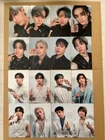
Stray Kids GIANT JAPAN First Limited A ver. Official Photocard Photo card PC
The accepted Mercari US observations for the same Price Guide record include seller-described sales at $11.75, $13.97, $17, and $19.35. Because these titles describe First Limited A, Tokyo Venue, Fan Club Limited, and Japan Ver. C, the comparison shows how platform access and version mix can overlap; it does not prove that eBay or Mercari US has a permanent premium.

Hyunjin Giant Japan Limited A Photocard
The Mercari Japan side is much thinner in the returned sample. NewJeans’ Supernatural Haerin record has one accepted Mercari Japan observation at $6.15; KCC’s monthly analysis records that as one accepted sale, one distinct card, and a $6.15 May 2026 average.

Haerin - Supernatural Japan Limited photocard

NewJeans SUPERNATURAL HAERIN ヘリン トレカ
For the same four-card slice, the eBay monthly rows show period averages from $5.95 to $13, with 1–3 accepted sales in the returned months. Mercari US appears in the listing evidence but not in that monthly result, so this is not enough to calculate a clean eBay-versus-Mercari-US-versus-Mercari-Japan regional premium. The honest conclusion is narrower: a Mercari Japan sale can sit below some U.S. observations, but these records do not hold the exact card, version, date coverage, and platform sample constant.
A better global-versus-U.S. comparison checklist
When two prices disagree, work through the comparison in this order:
- Match the card type: album PC, POB, Lucky Draw, Fansign, Broadcast, or another lane.
- Match the physical version: check the vendor, event, benefit name, album format, and seller photos or wording.
- Match condition: raw, visibly flawed, sleeved, or professionally graded cards should not be blended casually.
- Match the time window: use recent accepted sales and keep currencies clearly separated or converted consistently.
- Use sold evidence, not asking prices: a high listing shows what someone wants, not what a buyer accepted.
- Separate access cost from card value: add shipping, proxy, tax, and platform fees to your budget instead of folding them into the comp.
If one region has several comparable accepted sales and the other has only one listing, call the result what it is: a stronger local observation on one side and a weaker reference on the other. The comparison becomes more trustworthy when you state the evidence limit instead of pretending the two markets are equally visible.
What to do when the numbers still disagree
If you are buying: use the Price Guide range as a starting band, then open the accepted evidence and ask whether the seller is offering the same vendor or event version. If the only unusually high comp is graded, decide whether you are paying for the grade itself rather than for an ordinary raw card.
If you are selling: describe the version precisely, show condition clearly, and avoid anchoring your price to the highest listing or a reviewed outlier. A buyer in the U.S. may pay for convenience, but that does not make every local asking price a global benchmark.
The most useful definition of market value is therefore not one worldwide number. It is a range with an identity, a marketplace, a time window, and an evidence strength attached to it. Compare the card first, then compare the regions.
Save cards. Follow your artists.
Create a free account to save cards you love and keep up with your favorite artists.