
What Makes a Fansign Photocard Different From a POB?
Compare how fansign entry benefits and POBs enter circulation, what their labels can and cannot tell you, and how to verify an exact card before buying.
By Collector Guide
This guide explains the logic. See real price ranges and market behavior metrics inside the Price Guide.
Start with the route, not the rarity claim
If two listings show similar selfies but one says “fansign” and the other says “POB,” it is easy to assume the fansign card must be the rarer one. In the ATEEZ records below, fansign listings name event or entry campaigns, while POB listings name stores or campaigns; scarcity can follow either route, so the label is only the starting point.
When two listings show similar selfies, the useful first question is not “Which one is rarer?” It is “What campaign put each card into circulation?”
KCC treats Fansign and POB as separate card types. For ATEEZ’s GOLDEN HOUR : Part.4, the Price Guide has separate Fansign and POB records. Accepted listing titles then add campaign details such as event gifts, fan-sign events, and retailer names. Those labels give you a search direction, not an automatic ranking.
What each label tells you
In these listings, a fansign photocard is described through event or entry-campaign wording. A POB is described through the POB label and, in many of these titles, a retailer, store, or campaign name.
An official Weverse fansign notice says eligible buyers purchased the event album, entered the raffle, and received a special photocard for each album purchased. An official Weverse pre-order promotion says customers who spent at least USD 50 during the promotion received one special photocard for every USD 50 spent. These are campaign examples rather than universal definitions, but they show the practical route difference: one benefit is tied to entering a fansign campaign, while the other is tied to a pre-order offer. For ATEEZ’s GOLDEN HOUR : Part.4, both card types appear in the same album era.
That is why group, album, and member alone are not enough. For a closer match, record the card type, event or store, date if available, and any design nickname shown by the seller. “Exclusive photocard” by itself is too broad to establish one exact version when the accepted titles point to multiple campaigns.
Why scarcity is campaign-specific
These labels do not function as a fixed scarcity grade in the retained evidence. The Price Guide rows identify the album era, member, and card type, while accepted titles within the Yunho POB record name several different seller-described store versions.
The verified Yunho GOLDEN HOUR : Part.4 POB record is an umbrella row rather than proof of one single store version. Accepted titles in that Yunho POB evidence name hellolive, Fromm, Apple Music, MakeStar, Hello82, TOKTOQ, and Soundwave versions. A price from one store version should therefore be treated as evidence for that listing, not automatically transferred to every other POB from the era.
A higher or lower sale may reflect a different campaign, design, timing, or simply limited observations. These listings show that prices differed; they do not by themselves prove which explanation caused the difference.
The ATEEZ comparison: overlap matters
Yunho’s GOLDEN HOUR : Part.4 Fansign record is listed at $7.95–$10.45, while the matching POB record is listed at $9–$16.99. The ranges overlap, so this example does not support the shortcut that every fansign card is more valuable—or that every POB is the bigger chase.
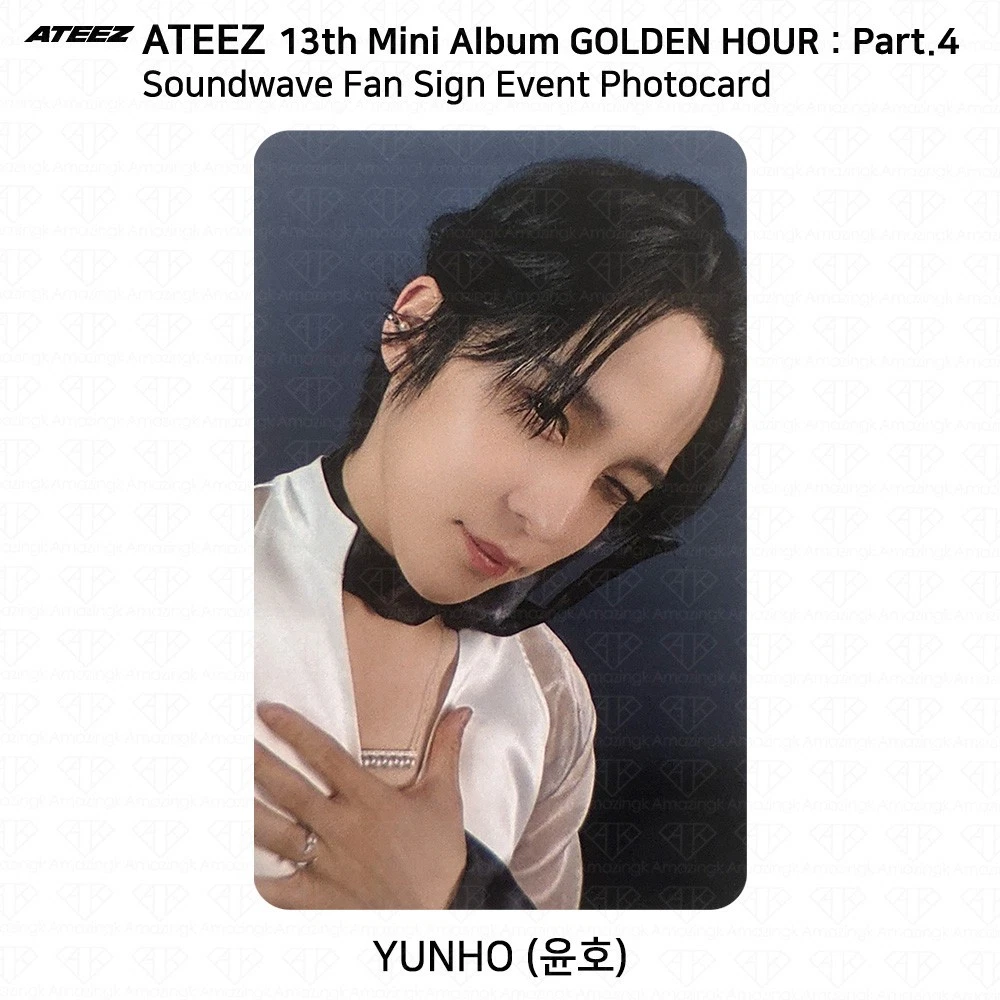
Yunho - GOLDEN HOUR : Part.4 Fansign photocard

Yunho - GOLDEN HOUR : Part.4 POB photocard
Both records carry a Healthy (liquid) label. In practical terms, the retained evidence is comparatively usable, but the label is not a promise that every exact event or store version will sell quickly. Use these ranges for orientation, then match the listing’s campaign and image as closely as possible.
Let sold titles narrow the identity
An accepted sale in the Yunho Fansign record was described as “[ATEEZ] GOLDEN HOUR : Part.4 / Apple Music Fansign Gift Photocard” and sold for $5.60.
![[ATEEZ] GOLDEN HOUR : Part.4 / Apple Music Fansign Gift Photocard sold listing](https://i.ebayimg.com/images/g/BbYAAeSwML9pm~UK/s-l500.webp)
[ATEEZ] GOLDEN HOUR : Part.4 / Apple Music Fansign Gift Photocard
An accepted sale in the Yunho POB record was described as “hellolive pob” and sold for $5.

ATEEZ (에이티즈) GOLDEN HOUR: PART. 4 ‘ hellolive pob ‘ Yunho photocard.
A separate retained listing in the Yunho POB record was described as “ATEEZ Yunho Golden Hour Part.4 Photocard Soundwave POB Aniteez Version” and sold for $28.21. At $28.21, that Aniteez Soundwave sale sits above the POB umbrella guide range of $9–$16.99. Because the listing identifies a specific Aniteez version while the guide row mixes store versions, treat it as an above-range version-specific observation, not the typical price for the umbrella row. These observations support the campaign details in the titles, but they do not establish a universal price for every Yunho Fansign or POB.

ATEEZ Yunho Golden Hour Part.4 Photocard Soundwave POB Aniteez Version
If a listing does not name an event, retailer, member, album, or recognizable version detail, pause before comparing it with a guide range. Request a clearer scan or image rather than using a different campaign’s sale as a substitute.
A buyer’s checklist
Before paying for a listing marked “fansign” or “POB,” check:
- Route: Is it tied to a named fansign or entry campaign, or does the title identify a retailer, store, or other POB campaign detail?
- Full identity: Record the group, album, member, event or store, date if available, and design nickname.
- Card type: Use the card-type label separately from an album PC when KCC distinguishes them.
- Exact evidence: Match the image and seller wording with accepted sales for that card, not a broad member average.
- Scarcity claim: Treat “fansign,” “POB,” and “exclusive” as route or campaign descriptors—not proof of a fixed print run or guaranteed premium; the overlapping Yunho ranges are a useful reminder.
- Umbrella warning: If a guide row sits at the album-era, member, and card-type level while accepted titles mix several event or store versions, use it as orientation and let exact sold listings guide the comparison.
Save cards. Follow your artists.
Create a free account to save cards you love and keep up with your favorite artists.