
How Much Is My BTS Photocard Worth? A Step-by-Step Valuation Guide
Identify, condition-check and value a BTS photocard using exact sold matches while filtering wrong versions, bundles, shipping distortions and outliers.
By KCC Team
This guide explains the logic. See real price ranges and market behavior metrics inside the Price Guide.
Start with one exact BTS photocard
Your BTS photocard does not have one automatic value because it shows a particular member. A useful estimate comes from three things: identifying the exact card, judging its real condition, and finding completed sales for genuinely matching copies.
Do those in that order. Searching “Jimin photocard sold” before you know the release and version will mix album pulls, POBs, lucky draws, replicas and bundles into one useless pile.
Step 1: confirm the identity
Write down the member, group or solo release, album or event name, version, card type, and retailer or venue. Compare the front image, back design, logo placement, crop and printed text with a trusted checklist or KCC card.
“Jin ECHO photocard” is too broad. The album inclusion, Weverse POB and lucky draw are separate products. “Jin ECHO Weverse POB” is a usable identity.
If the seller cannot show the back, pause. If the corners, crop or finish differ from known copies, verify authenticity before pricing. A fake card does not become a comp because its title says “official.”
Step 2: record the condition honestly
Look at the card under angled light, front and back. Check for factory ink smudges or print marks, dents, pressure marks, creases, surface scratches, scuffs, edge whitening, soft corners, water damage and fading.
Separate a removable speck on a sleeve from damage on the card. Photograph every issue clearly. Buyers care about a dent they can see; hiding it creates disputes and makes your asking price hard to defend.
There is no honest universal rule such as “one scratch removes 20%.” A tiny factory dot and a deep face scratch do not affect buyers equally. KCC’s current schema does not store a condition grade, so build the clean-card baseline first. Then place a damaged copy below that clean cluster, explain the defect and keep the range wider.
Step 3: find completed, exact matches
Search sold listings using the full identity. Keep a comp only when the member, image, back, release, version and distribution type match. Check the listing photos instead of trusting the title.
Prefer several recent single-card sales. Include shipping in the buyer’s total and convert currencies consistently. A $12 card with $8 shipping is a $20 purchase. Do not compare that with a $14 shipped sale as though the first card cost only $12.
Active listings show seller hopes. They do not show what a buyer paid. Use them to see availability, then anchor the estimate on completed sales.
Step 4: remove bad comps
Drop the listing when it contains a different version, several photocards, an album, a DVD, a game code, signed goods or other extras. Remove obvious replicas and listings whose photos do not prove the claimed identity.
Also separate outliers. A genuine sale can still be a bad baseline when it is far from the rest of the matching cluster or includes something special. Keep a note of it, but do not let one dramatic number set the value.
The BTS World Jimin card shows why this matters. KCC’s guide range is $10.00 to $20.33 with a $12.38 midpoint. A single-card eBay sale at $8.50 is a useful nearby observation.

Jimin - BTS World: Original Soundtrack Album PC photocard

BTS World Jimin Photocard (OFFICIAL)
Another $103 listing used the same broad card identity, but the product included the original soundtrack package and an unused game code. KCC excluded it from the guide range. That sale measures a different package, so using $103 as the loose Jimin card’s value would be a major mistake.

BTS WORLD Original Soundtrack OST Album JIMIN PHOTOCARD Game Card Code RARE
Step 5: turn the good comps into a range
Put the matching buyer totals in order. Use the main cluster as the working low and high. The middle of that cluster is a useful reference, but keep the actual spread visible.
If you have six clean single-card sales between $9 and $13, a $40 ask deserves suspicion. If you have only one $12 sale, do not pretend that $12 is exact. Search longer, check another marketplace, or publish a wider range with a clear note that evidence is thin.
Choose the lower end when you want a quick sale. A patient listing can start nearer the middle or upper end when the card is clean and current supply is low. This is a pricing decision, not proof that the card is worth the highest number.
Worked example: a clean Jin POB
KCC places the Jin ECHO POB at $12.00 to $17.60 with a $15.00 midpoint. An accepted single-card eBay comp sold at $19.99. Together, those give a clean seller a sensible area to investigate rather than permission to copy the highest active ask.

Jin - echo POB photocard
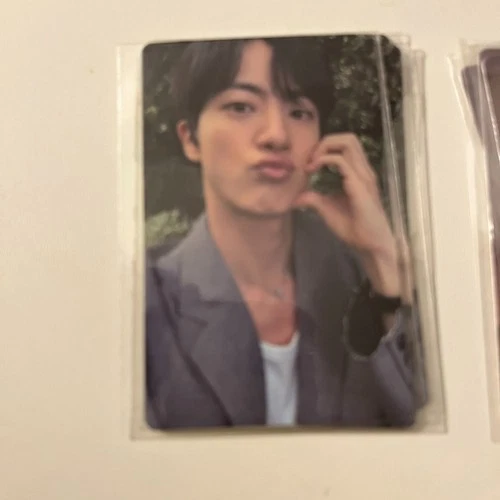
JIN BTS Weverse POB Photocard Album ECHO Official Kpop
An excluded $49.99 sale sits far above the stable evidence. Keep it out of the baseline unless new matching sales show that buyers have moved into the same area.

JIN BTS Photocard Album ECHO Official POB WEVERSE Kpop
Worked example: a card with damage
Imagine the same Jin POB has a visible surface scratch and a small back dent. First find the clean-card range using exact sold copies. Photograph both flaws under angled light. Then search specifically for damaged copies of the same card.
If no damaged match exists, list below the clean cluster and allow a wider negotiation range. Do not invent a percentage deduction. The useful facts are the clean baseline, the precise defects and the amount a real buyer accepts.
Your final check
Before listing or trading, you should be able to answer: Is this the exact version? Is it official? What flaws can a buyer see? Which sold listings match it? Did those prices include shipping? Did I remove bundles and outliers? How many good comps remain?
Save the links and dates you used. Market evidence changes, so recheck it when you are ready to transact. A careful range backed by three strong matches is far more useful than one exciting screenshot.
Save cards. Follow your artists.
Create a free account to save cards you love and keep up with your favorite artists.