
Most Expensive K-Pop Photocards in 2026: Reported Sales
Compare famous reported K-pop photocard sales with current KCC guide ranges, graded premium examples, rare events, broadcasts, and POBs.
By KCC Team
This guide explains the logic. See real price ranges and market behavior metrics inside the Price Guide.
The best-known public single-card record
Records in K-pop photocard collecting are best read as public examples, not a complete official leaderboard. The most widely repeated single-card example is BTS Jungkook’s Butterful Lucky Draw event card, reported at $3,213 after 120 bids, while older roundups show other broadcast and event cards in the hundreds. A separate $5,106 Dreamcatcher Gahyun figure was reported for a set, not clearly for one card, so it belongs in a different comparison. This guide separates those historic claims from KCC’s current price-guide ranges and reviewed sold observations.
The most frequently cited high-water mark is BTS Jungkook’s Butterful Lucky Draw event photocard. A 2021 report says the card sold on eBay for $3,213 after 120 bids. That makes it a useful public benchmark, but not proof that every expensive Jungkook card—or every rare K-pop card—belongs in the same price tier.
Older public lists show how quickly prices can change by card type and moment. One list included a Jennie “Solo” broadcast photocard at $450, while another reported a Seulgi Superstar SMTOWN Halloween event card at $640. Those examples are still valuable historical context, but they should be labeled as reported public sales rather than treated as a permanent ranking.
Why a set should not be ranked beside a single card
The phrase “most expensive photocard” often hides an important distinction: is the number for one card, a complete member set, or a bundled lot? A Reddit post discussing an eBay recommerce report described a Dreamcatcher Gahyun photocard set selling for $5,106, and the discussion itself emphasized that it was a set rather than one photocard.
That figure may be eye-catching, but it is not directly comparable with Jungkook’s reported single-card sale. Before comparing any record claim, label it as single, set, or lot. If the original sale does not make that clear, treat the number as a lead for research—not a confirmed record.
KCC’s current high-end snapshot
KCC’s current guide snapshot answers a different question from a historical record list: which tracked cards currently have the highest guide ranges and accepted sold observations? The examples below are not a KCC verification of the Jungkook sale; they show how the present premium market looks across different groups and card types.
LE SSERAFIM Huh Yunjin’s “Crazy” Japan Limited photocard is tracked from $66 to $300 USD. KCC also records an accepted eBay sale of a PSA 10 graded copy at $300 on May 31, 2026, placing that graded sale at the top of the guide range. Do not treat the graded result as the going rate for an ungraded copy.
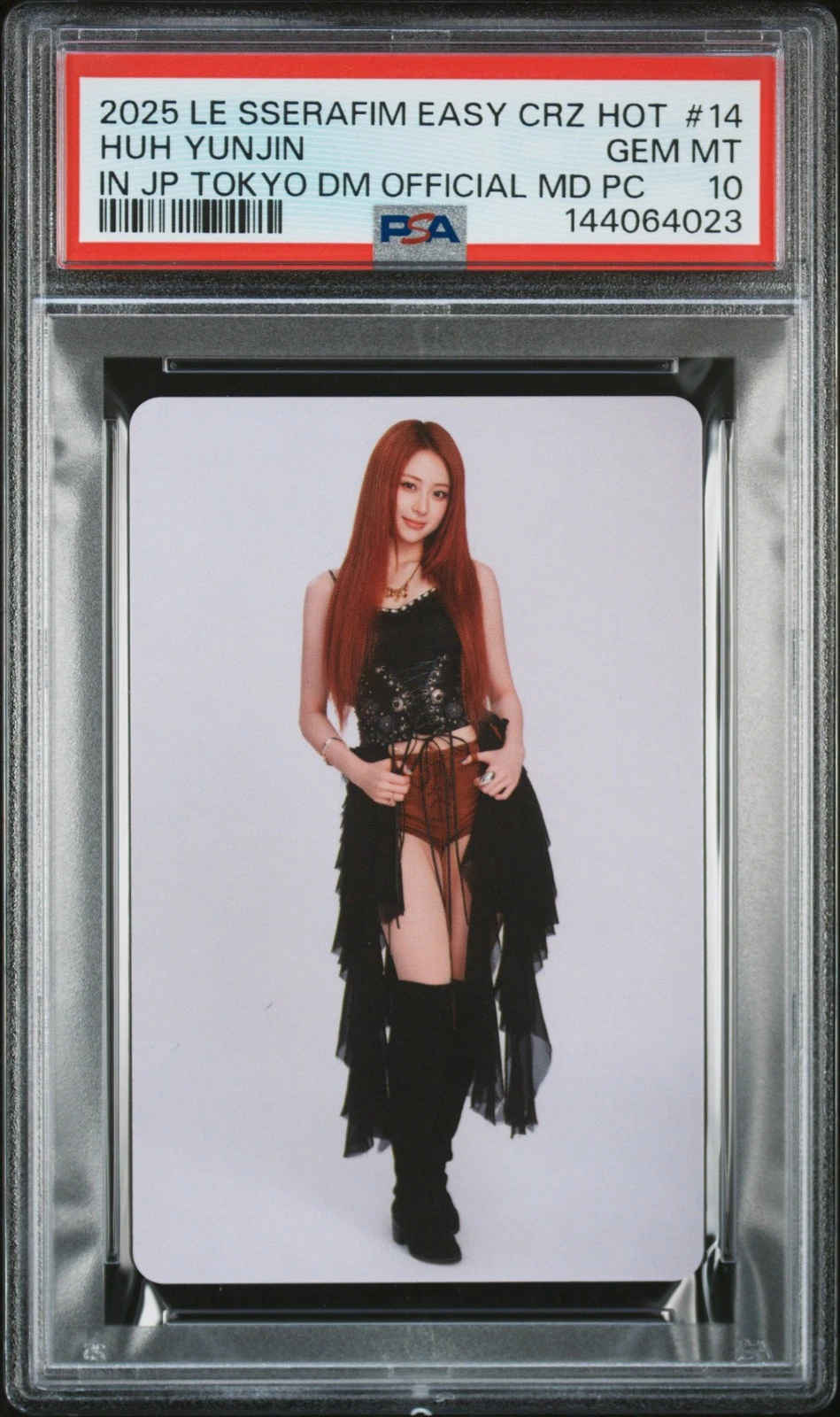
Huh Yunjin - Crazy Japan Limited photocard

2025 LE SSERAFIM TOUR EASY CRAZY HOT IN JAPAN TOKYO DOME HUH YUNJIN PSA 10
BLACKPINK Jennie’s “Mantra” POB is tracked from $113.61 to $284, with an accepted eBay sale of a PSA 10 graded copy at $284 on July 12, 2026. The supporting high-end sales are graded, so this range should not be treated as a raw-card benchmark.

Jennie - Mantra POB photocard

2024 Jennie Mantra Weverse MD POB Shirt/Short C Photocard PSA 10
KCC also tracks KPop Demon Hunters’ Zoey “Golden” 7-inch Vinyl album PC from $100 to $260. One accepted eBay observation for a PSA 10 graded copy sold for $175.50 on July 15, 2026. That makes it a graded premium example, not a direct benchmark for an ungraded copy.

Zoey - Golden 7" Vinyl Album PC photocard
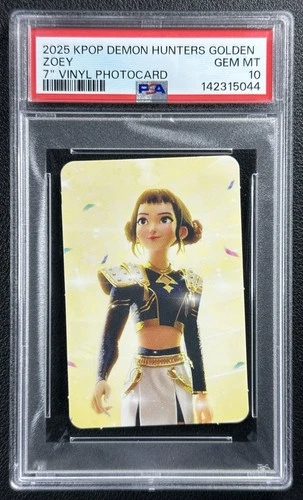
ZOEY PSA 10 2025 KPOP DEMON HUNTERS GOLDEN 7" VINYL PHOTOCARD 5044
These current KCC examples top out below the famous $3,213 historical claim, but they make the market easier to interpret: the top end is not one universal price ladder. It is a mix of limited distribution, member demand, condition, timing, and the amount of reliable evidence available.
The recurring pattern: restricted distribution
Historical expensive-card roundups repeatedly feature broadcast, fan-event, lucky-draw, and other restricted-distribution cards rather than ordinary album pulls. KCC’s current rows show that same pattern in a more modest but concrete way.
BIGBANG G-Dragon’s Special Event 2017 Fanmeeting photocard is tracked at $172.96, with an accepted Mercari Japan sale at the same price on May 20, 2026. A fanmeeting card carries a different supply story from a standard album inclusion because collectors cannot simply open more albums to find it.

G-Dragon - Special Event 2017 Fanmeeting photocard

BIGBANG SPECIAL EVENT 2017 G-DRAGON トレカ
NewJeans Hanni’s “Get Up” Broadcast photocard is tracked from $86.70 to $172.89, and KCC records an accepted eBay sale at $172.89 on June 21, 2026. Danielle’s related broadcast row is tracked separately, which is a reminder that member, version, and exact distribution can matter even within one era.

Hanni - Get Up Broadcast photocard

NewJeans HANNI Get Up Sanok Broadcast Official Limited Photocard PC New Jeans
Neither example is a historical record, and neither should be used to predict every broadcast or fanmeeting card. They simply illustrate why restricted distribution often creates a premium: the supply is narrower, and the right buyer may have fewer substitutes.
How to read a KCC range without overpaying
A KCC price guide range is more useful than a single dramatic number because it shows low, mid, and high observations. The high endpoint is not a guaranteed resale price. Compare it with the card’s type, condition, date, marketplace, and liquidity label before deciding what a fair offer looks like.
The current examples also show why price and resale ease are separate signals. KCC labels the Yunjin Japan Limited row “Premium (watch comps)”, while the Jennie POB, G-Dragon fanmeeting, and Hanni broadcast rows are labeled “High” liquidity. A card can have a high ceiling and still require patience or especially strong matching comps.
Evidence quality matters too. Check whether a comp is graded, bundled, damaged, or otherwise unlike the copy you are pricing before using it to set a range.
When a historic headline and a current guide disagree, do not force them into one ranking. First normalize the unit being compared—single card, set, or lot—then compare like-for-like sales with similar condition and distribution.
Checklist before paying a record-like price
Before buying an ultra-expensive photocard, work through this checklist:
- Identify the exact item. Confirm the group, member, era, card type, version, and whether the price covers one card or multiple cards.
- Confirm it was sold. Separate completed sales from asking prices, canceled listings, starting bids, and screenshots without a clear outcome.
- Compare like-for-like evidence. Look for more than one recent sold comp, and account for grading, condition, shipping, currency, and marketplace.
- Inspect authenticity and provenance. Rare event, broadcast, and benefit cards deserve clearer photos and stronger seller proof than ordinary album pulls.
- Treat scarcity as context, not a guarantee. A card can be hard to replace and still fail to repeat one unusually high sale.
- Set your ceiling first. Decide what the card is worth to you before hype, competition, or a “record” label changes the decision.
The bottom line is simple: Jungkook’s reported $3,213 sale is a famous public benchmark, but Gahyun’s reported $5,106 set is a different category. KCC’s current data gives collectors a more practical view of today’s premium segment, from Japan-limited cards and POBs to fanmeeting, broadcast, and newer album PCs. Use historic sales for context, KCC ranges for comparison, and your own collecting goals as the final limit.
Save cards. Follow your artists.
Create a free account to save cards you love and keep up with your favorite artists.